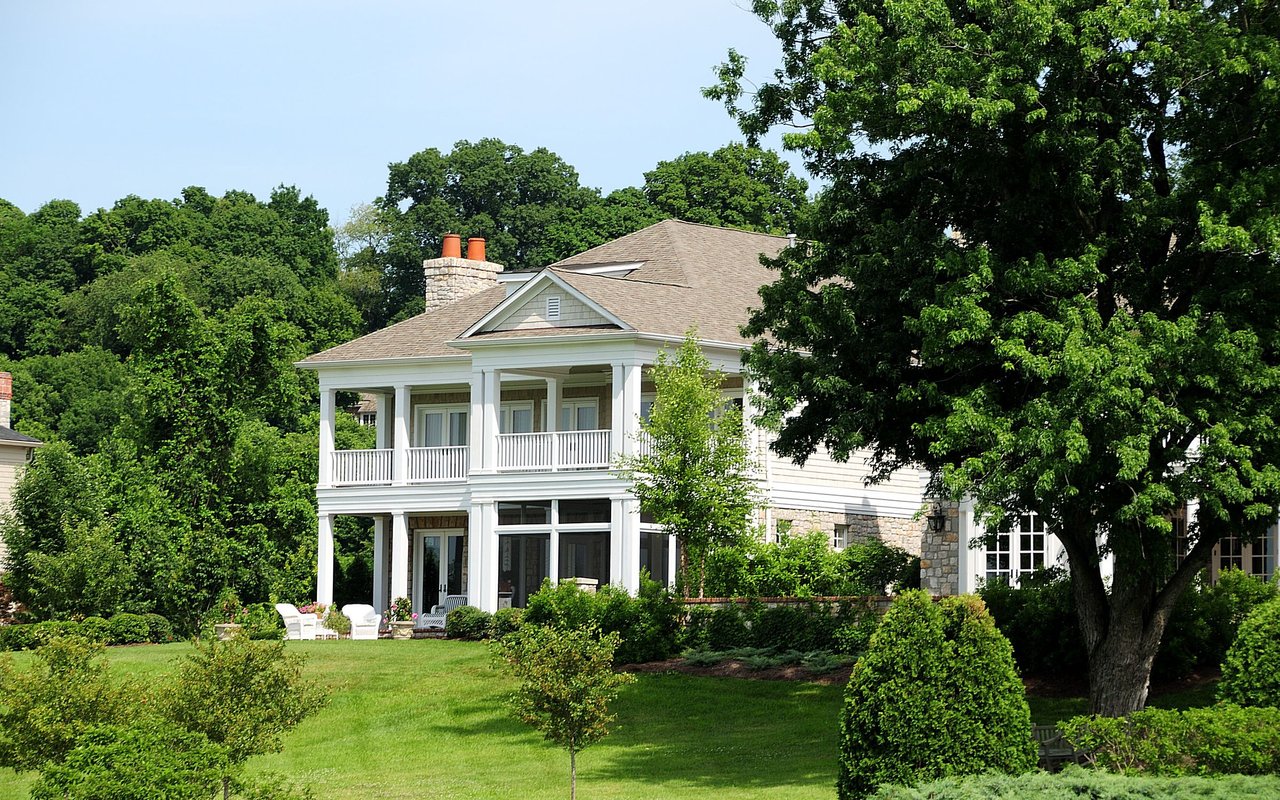
Indian Hills & Mockingbird Valley
Indian Hills and Mockingbird Valley feel remarkably removed from the city's commercial pace.
Indian Hills and Mockingbird Valley feel remarkably removed from the city's commercial pace.
Tucked into Louisville's northeastern corridor between Brownsboro Road and the Ohio River, Indian Hills and Mockingbird Valley offer a rare sense of retreat within minutes of the city's everyday conveniences. Mature trees, limestone outcroppings, winding roads and generous setbacks give both communities an established, almost country-like atmosphere. Yet each has its own personality: Indian Hills is larger and more varied, while Mockingbird Valley is exceptionally small, quiet and secluded.
These are places where the land matters as much as the house. Topography, tree canopy, privacy and the way a home sits on its lot often shape the experience more than square footage alone. Traditional architecture is prominent, but buyers will also find mid-century residences, thoughtfully renovated homes and custom properties designed around wooded slopes, creek corridors or river-bluff views.
Both are incorporated home rule-class cities within Jefferson County and use Louisville mailing addresses. Municipal identity can influence services, permitting and local regulations, so the exact address and city boundary should always be confirmed during a home search.
Indian Hills and Mockingbird Valley feel remarkably removed from the city's commercial pace. Roads bend with the natural terrain, homes are softened by mature landscaping, and many lots preserve a sense of space that is increasingly difficult to find close to downtown Louisville. The landscape changes from broad lawns and established neighborhood streets to deeply wooded hillsides, creek valleys and dramatic limestone formations.
Despite the peaceful setting, residents remain close to the restaurants, shopping and services of St. Matthews and the Brownsboro Road corridor. Downtown Louisville, the Highlands, Crescent Hill and Clifton are also within practical reach, making both communities appealing to buyers who want privacy without feeling disconnected.
The housing stock reflects generations of careful development rather than one uniform building period. Indian Hills offers an especially broad mix, including traditional two-story homes, classic ranches, mid-century designs, large custom residences and estate properties. Mockingbird Valley is more limited in scale and inventory, with many homes set well back from the road on substantial, naturally landscaped parcels.
Brick, stone, wood siding and other enduring materials are common. Renovations often focus on updated kitchens, more open living spaces, primary suites and outdoor entertaining areas while preserving the proportions and craftsmanship that give older homes their appeal.
River Road provides a scenic thread along the northern edge of this part of Louisville. It connects residents to the Ohio River corridor, nearby parks and recreation, and an easy route toward downtown. Caperton Swamp Park, located on River Road, is a 29-acre passive park with a soft-surface trail around wetlands and wooded habitat. It offers an unusually quiet nature experience in the middle of the metropolitan area.
The river and surrounding lowlands also make property-specific due diligence important. Floodplain status, drainage, access during high-water events and the elevation of a particular parcel can vary considerably within a short distance.
Both communities are known for a carefully preserved residential character. Large trees, natural rock, creek corridors and established setbacks help create the setting, while local municipal rules guide construction, additions and property use. For homeowners, this can provide continuity and a strong sense of place. For buyers planning a major renovation, pool, accessory structure or new build, early review of local requirements is essential.
Indian Hills is the larger of the two communities and offers the widest range of neighborhood experiences. Some streets feel formal and estate-oriented; others have a relaxed, established residential rhythm with ranch homes, mid-century architecture and traditional two-story houses. What ties the area together is the landscape: rolling ground, mature woodland, rock outcroppings and the Muddy Fork of Beargrass Creek.
The community's name traces to Indian Hill Stock Farm, an early local farm associated with John Veech. Over time, the former agricultural land became a collection of residential sections shaped by the natural terrain. The present-day city was reincorporated in 1999 after the consolidation of several local municipalities, which helps explain why buyers may still hear older section names used in conversation and real-estate listings.
A notable amount of land in Indian Hills remains wooded or intentionally undeveloped. These green spaces, together with creek corridors and the nearby Caperton Swamp, support the community's unusually natural feel. Portions of the landscape were influenced by the Olmsted Brothers tradition of working with topography rather than imposing a rigid street grid.
This environment is beautiful, but ownership can involve active stewardship. Mature-tree assessment, stormwater movement, slope stability, retaining walls, erosion and seasonal drainage should be part of the evaluation of any property with challenging terrain.
Indian Hills is primarily residential, so daily errands generally happen just beyond the city limits. Brownsboro Road provides quick access to groceries, dining, medical offices and neighborhood services. St. Matthews expands those options with major shopping destinations and a broad restaurant scene. Cherokee Park, Seneca Park and the riverfront trail system add additional choices for walking, cycling and outdoor time.
The location also offers useful flexibility for commuting. U.S. 42 and Brownsboro Road lead toward downtown, while nearby connections to Interstate 71 provide regional access. Actual drive times vary with the exact street, school traffic and peak-hour congestion.
Mockingbird Valley is one of Louisville's smallest incorporated cities, covering roughly one-fifth of a square mile. Its limited scale is central to its character. The community reads as a discreet country enclave, with winding roads, dense tree cover, rolling terrain and substantial homes positioned for privacy.
The area's residential history reaches back to the nineteenth century. Rock Hill, built near River Road in 1840, remains an important early landmark. In the early twentieth century, Louisville residents began establishing summer houses here; improved transportation gradually made year-round living practical. Later residential additions were developed slowly, preserving the layered, nonuniform quality seen today.
Mockingbird Valley has no conventional commercial center and very little through traffic. Many properties rely on long approaches, landscaping and natural topography rather than closely spaced houses. Stone walls, bridges, wooded slopes and exposed limestone contribute to the area's distinctive sense of arrival.
Some roads are privately owned or maintained, so buyers should verify maintenance responsibilities, shared agreements, access rights and snow or storm cleanup. These details may be addressed through recorded documents rather than a typical neighborhood association.
River Road places Mockingbird Valley near waterfront recreation, cycling routes and parks, while Brownsboro Road and St. Matthews handle most everyday shopping and dining. The Louisville Country Club and Louisville Boat Club are nearby private membership institutions, and the area's proximity to downtown makes museums, performing arts and major events accessible without sacrificing the residential setting.
Both communities are within Jefferson County Public Schools. School assignments, magnet options and transportation policies can change and should be verified for the exact property address directly with the district. A Louisville mailing address or a familiar neighborhood name does not guarantee a particular assignment.
The broader east Louisville area also provides access to a number of independent and faith-based schools. Admission, grade levels, transportation and enrollment availability vary by institution, so buyers should confirm current details rather than relying on proximity alone.
Many residences were built decades ago and may include additions from different periods. A thorough inspection should consider roofing, windows, electrical service, plumbing, foundation conditions, waterproofing, sewer connections, fireplaces, drainage and the quality of prior renovations. For heavily wooded properties, an arborist's review can be as useful as a conventional home inspection.
Indian Hills and Mockingbird Valley deliver two of Louisville's most distinctive residential settings. Indian Hills offers greater variety and a larger neighborhood network, while Mockingbird Valley offers a bit more rarity and privacy. Both reward buyers who appreciate mature landscapes, established architecture and proximity to the city without a conventional suburban feel.
Experience trusted guidance, personalized service, and proven expertise with Nancy, dedicated to helping you achieve your real estate goals with confidence.

Nancy Stevens
1757 Frankfort Ave Louisville, KY 40206


